
How long does an EV take to charge?
It depends on the charger, your battery and how full it already is. Here are typical times for UK chargers, how the estimate works, and how FillRadar works it out for you on every charger in the app.
schedule Typical charging times
A 60 kWh battery, a typical family EV, charging from 20%. Times are estimates; your car's own charging curve decides the real figure.
| Charger | Where you find it | 20% to 80% | 20% to 100% |
|---|---|---|---|
| 3.6 kW | Slow home socket or post | 11 hr 46 min | 15 hr 42 min |
| 7 kW | Home wallbox, workplace, street | 6 hr 4 min | 8 hr 5 min |
| 22 kW | Destination post (most cars take 11 kW) | 3 hr 52 min | 5 hr 9 min |
| 50 kW | Rapid | 46 min | 1 hr 31 min |
| 150 kW | Ultra-rapid | 16 min | 31 min |
Taking 60 kWh from 20% to 80% puts 36 kWh into the battery. With charging losses that is about 42 kWh from an AC charger or 38 kWh from a rapid one, so at 49p a kWh it costs roughly £21 on AC and, at a typical 79p rapid tariff, about £30.
functions How the estimate works
- AC charging (up to 22 kW posts) is limited by the car's onboard charger, so FillRadar caps it at 11 kW and assumes 85% efficiency. Power stays steady all the way to 100%.
- DC rapid charging runs at the charger's power with 95% efficiency up to 80%, then at a third of that power for the last 20%, because cars slow down as the battery fills.
- Cost is the energy drawn from the charger, losses included, times the price per kWh. Connection fees, parking and overstay charges are not included.
It is an estimate. Real charging depends on your car's own charging curve, battery temperature, and whether the charger shares power with another car. Use it to compare chargers, not to time a stop to the minute.
ev_charger On every charger in the app
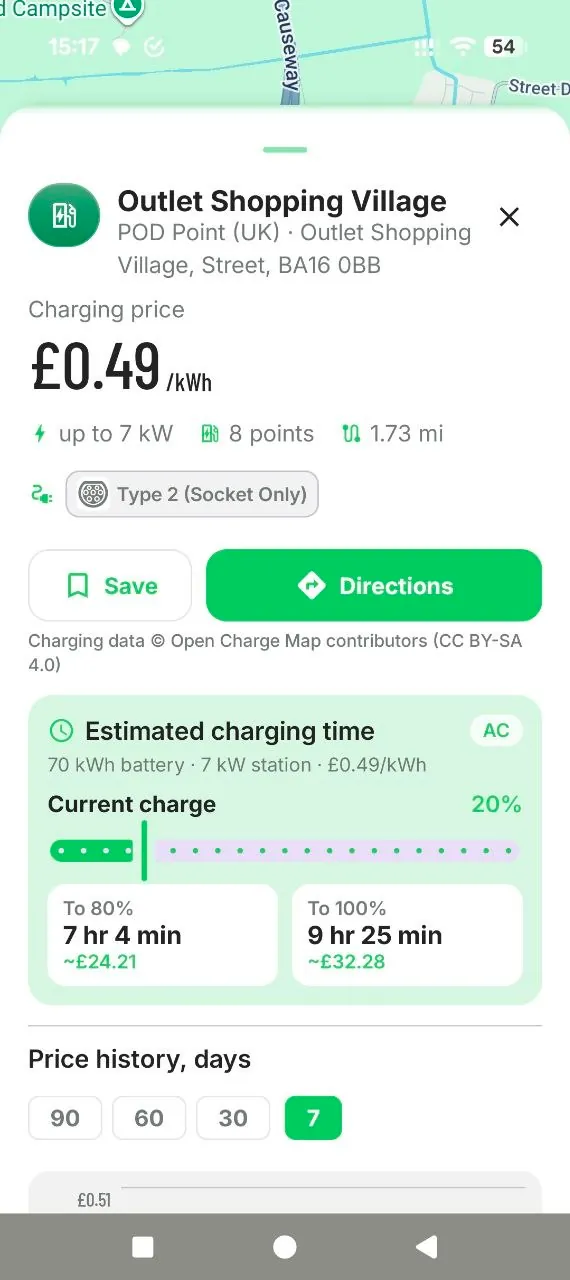
FillRadar puts over 27,000 UK charging locations on the same map as fuel. Open a charger and the app fills in its power and tariff for you, uses your car's battery size, and shows the time and cost to 80% and 100%.
- Connector types (Type 2, CCS, CHAdeMO) and power for each location.
- Community-reported tariffs, with price history and alerts when a saved charger's price moves by 1p a kWh.
- Best-value sorting that weighs the price against the drive there and back.
Charging data © Open Charge Map contributors (CC BY-SA 4.0). Tariffs can lag behind the operator.
quiz Charging questions
How long does it take to charge an EV on a 7 kW charger?
With a 60 kWh battery, going from 20% to 80% takes about 6 hr 4 min on a 7 kW home or destination charger, using the assumptions below. A full charge takes longer.
How long does a 50 kW rapid charger take?
About 46 min to take a 60 kWh battery from 20% to 80%. Above 80% most cars slow right down, so FillRadar assumes a third of the power for the last 20%.
Why does charging slow down after 80%?
On DC rapid chargers the car reduces power as the battery fills, to protect it. That is why journey planning usually stops at 80%.
Why is my car slower than the charger's rating on AC?
On AC the car's own onboard charger sets the limit, often 7 or 11 kW. A 22 kW post cannot charge faster than that, so FillRadar caps AC charging at 11 kW.
How is the cost worked out?
Energy taken from the charger, including charging losses, multiplied by the price per kWh. It does not include connection fees, parking or idle charges.
explore More from FillRadar
Charging and fuel on one map
FillRadar is in closed beta on Android. Request early access for your Google Play invitation.
Request Early Access